

Introduction
CloudFest EU 2026 made one thing clear:
WordPress isn’t shrinking, but the rules around it are changing.
It still powers a massive share of the web and dominates the CMS landscape. But for hosting providers, success is no longer about simply offering WordPress.
It’s about the experience you wrap around it.
In the session “WordPress by the Numbers,” James Lee, Group Product Manager at WebPros, focused on what the data actually shows across the ecosystem, and what it means in practice.
Here are the key insights from the session.
Watch the Full Session
If you prefer to see the full session, including the data and insights shared on stage, you can watch it here:
The Scale of WordPress Today
The session started with one thing: scale.
Through WebPros Insights, we now have visibility into a significant portion of the live web. Every month, over 2.3 billion hostnames are scanned, with nearly a billion active sites and trillions of visits tracked across those environments.
What this means is simple:
We’re no longer looking at isolated data points or small samples. We’re looking at real patterns across the web at scale.
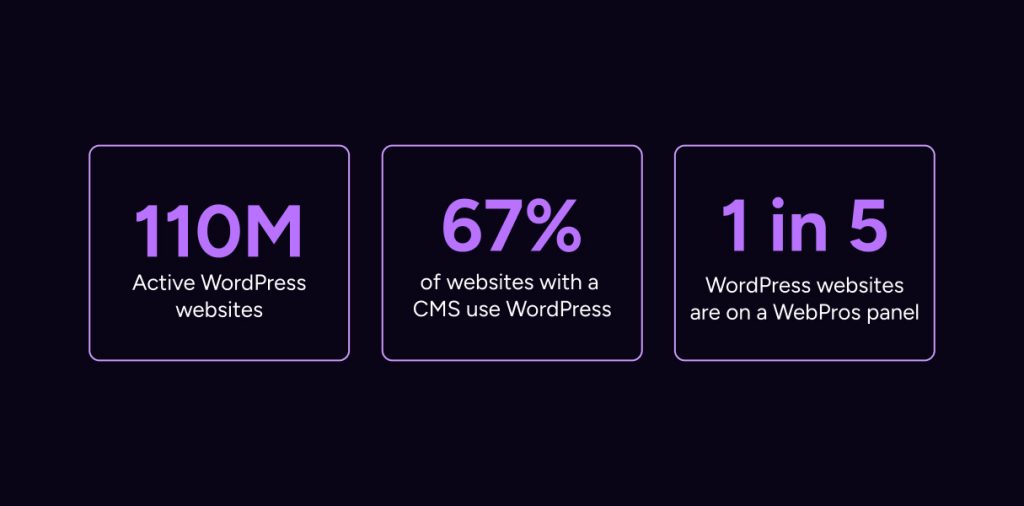
And at that scale, one thing is still clear. WordPress remains dominant, powering around 100 million websites and accounting for 67% of all CMS-based sites.
But the value of this data isn’t just confirming that WordPress is big. It’s that we can now see how it’s evolving, and where the pressures are starting to appear.
But scale alone does not tell the full story.
A Market That Is Shifting
For years, WordPress felt like it was on a constant upward curve. That momentum has now stabilised. Growth has stabilised. Not declining, but no longer expanding at the same pace. The total number of WordPress sites has stabilized after peaking, with a gradual shift over time.
This is an important signal.
It suggests that while WordPress continues to operate at scale, it is now competing in a more dynamic environment, where simpler, more guided platforms are becoming viable alternatives for certain users.
The takeaway is not that WordPress is losing relevance.
It is that the market around it is evolving. That shift becomes clearer when you look at how the hosting market is structured.
The Hosting Landscape Is Highly Competitive
Competition becomes most visible in the hosting landscape. In that environment, infrastructure alone is no longer enough to stand out.
There are over 1,100 hosting providers competing for WordPress sites, but the market is not evenly distributed. A small group of top providers controls a large share of the ecosystem, while only a limited number have reached significant scale in terms of WordPress sites hosted.
Between these two ends sits a large group of mid-sized providers. They collectively control a meaningful portion of the market but operate in a space where differentiation is becoming harder.
These patterns are also reflected in the Web Hosting Trends Report 2026, where providers consistently point to increasing competition and the need to differentiate beyond pricing and infrastructure.
Competing on infrastructure alone is no longer enough. What customers actually experience, how easy it is to get started, manage a site, and trust the platform, is where differentiation now happens.
Inside the Plugin Ecosystem
Looking inside WordPress sites, the plugin ecosystem reveals how users are actually building and running their websites.
Page builders continue to play a major role, with a large share of sites relying on them for layout and design. Ecommerce is also a significant use case, with many sites running WooCommerce to power online stores.
At the same time, the data highlights a clear gap.
81% of WordPress sites do not have a dedicated security plugin installed, highlighting a significant gap. This reflects how users actually behave. They prioritise speed and simplicity, often at the expense of best practices. In other words, complexity isn’t being managed. It’s being avoided.
It also reinforces a broader point from the session.
How WordPress is used in the real world is often very different from how it is expected to be used. Taken together, these patterns point to a few clear signals.
Three Signals That Matter
Across all of this, three patterns stand out, and each has direct implications for hosting providers.
Signal 1: Managed WordPress Is Becoming the Baseline
Managed WordPress hosting is no longer a premium offering. It is becoming an expectation. A growing number of providers already offer it, and many see it as a key growth opportunity.
The implication is simple. Customers expect a managed experience by default. The question is whether you offer it, and how well you deliver it.
Signal 2: Security Is a Churn Problem
Security is often treated as a technical issue, but data from the Web Hosting Trends Report 2026 shows it is also a retention issue. 19% of customers leave after a security incident.
Vulnerable plugins remain one of the biggest challenges for providers. When something breaks, customers do not just fix it. They leave.
This shifts how security should be viewed. It is not just about protection, but about maintaining trust and preventing churn.
Signal 3: Experience Is Driving Churn
A growing number of users are leaving traditional hosting environments for simpler, more guided platforms.
This includes both SaaS website builders and fully managed WordPress experiences. Once users move to these platforms, winning them back becomes significantly harder.
Price alone is not enough to compete. The real differentiator is experience, how easy it is to get started, manage a site, and see results.
What This Means in Practice
Put together, these signals point to a clear shift:
WordPress is still operating at scale, but expectations around it have shifted. Users now expect simplicity, reliability, and a more guided experience.
For hosting providers, this changes the role they play. It is no longer just about providing infrastructure. It is about delivering a complete, easy-to-use product.
This is also where the opportunity lies.
Providers that can reduce complexity, improve onboarding, and build more seamless workflows are better positioned to retain customers and compete with simpler, more packaged alternatives. The opportunity is not in adding more features. It’s in removing friction.
How We Are Responding
To address the growing demand for managed experiences, we are making it easier for providers to offer Managed WordPress hosting, whether for agencies running smaller environments or providers operating at scale. The focus is on reducing setup time and delivering a ready-to-use experience.
On the security side, the approach is to make detection and protection more accessible. Vulnerability detection is built into WP Toolkit, with visibility available directly within WordPress environments. Protection can then be layered without upfront cost, allowing providers to offer it as part of their service or as an upgrade.
We are also focused on reducing friction in onboarding. With self-service website import, users can move existing WordPress sites without manual migration, bringing over content, plugins, and configurations with minimal effort.
Across all of this, the goal is consistent.
Make WordPress easier to offer, easier to manage, and easier to use, without adding complexity.
What to Do Next
The data doesn’t just describe where WordPress is today. It highlights what needs to change.
WordPress is still dominant, but expectations around it have shifted. Users want simplicity, reliability, and guidance.
For hosting providers, the path forward is clear. Not to move away from WordPress, but to rethink how it’s delivered. Because in this next phase, the advantage won’t come from having WordPress.
It will come from making it feel effortless.