

The Web Hosting Trends Report surveyed 446 hosting providers globally and the AI signal is clear: 36% identify integrated AI and automation as the single biggest innovation gap across hosting platforms, ranking it ahead of security (19%), CMS integrations (17%), and centralized management (15%) combined. 53% expect AI-driven automation to have the biggest impact on the hosting industry in the period ahead.
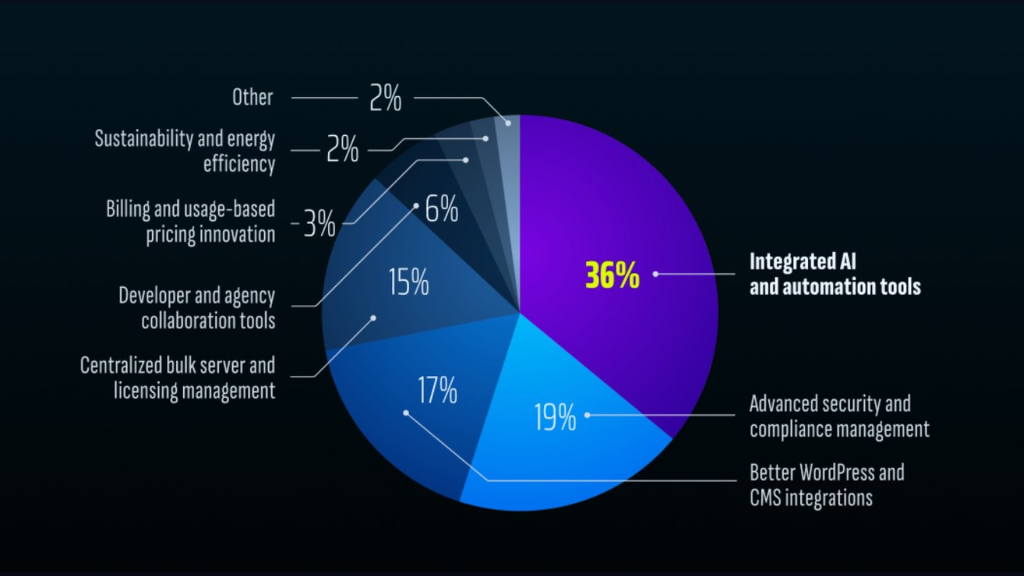
In the next 2-3 years, where do you see the BIGGEST innovation opportunities, for control panels and web infrastructure software?
At the same time, 27% of providers have not implemented any AI solutions at all.
The gap between expectation and adoption is where the opportunity sits. This post breaks down what the data shows about where AI delivers the most value in hosting, what providers are already doing with it, and four specific moves worth making if your team is still deciding where to start.
Where Hosting Providers Are With AI Right Now
AI adoption in hosting is real but unevenly distributed. The Web Hosting Trends Report provides a clear snapshot:
36% already use AI in customer support, primarily through chatbots and reply suggestions. 32% offer AI-powered tools directly to customers, such as website builders and content generators. 30% use AI for server monitoring and optimization, including anomaly detection and smart alerting. 29% deploy AI for cybersecurity threat detection. 27% have not implemented any AI solutions yet.
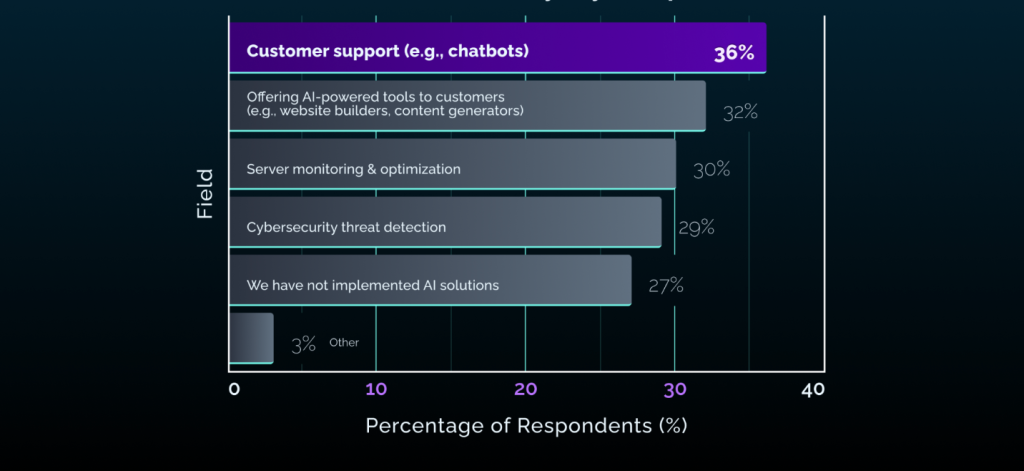
In which areas have you already implemented AI solutions successfully in your operations?
Two things stand out. The providers who have started with AI concentrated their initial efforts in support, security, and monitoring, the three areas where operational pressure is highest and the return on automation is most immediate. And more than a quarter of the industry has not started at all, which means the competitive window for early adopters is still open.
The Operational Pressure Driving Adoption
The AI demand data does not exist in a vacuum. It maps directly to where hosting teams are spending the most time and absorbing the most cost.
The Web Hosting Trends Report identifies the four largest consumers of support time across the industry: email problems including spam, blacklisting, and deliverability (42%), CMS and application issues such as plugin conflicts and installation help (39%), performance issues including slow sites (35%), and security incidents including hacked sites and malware (35%).
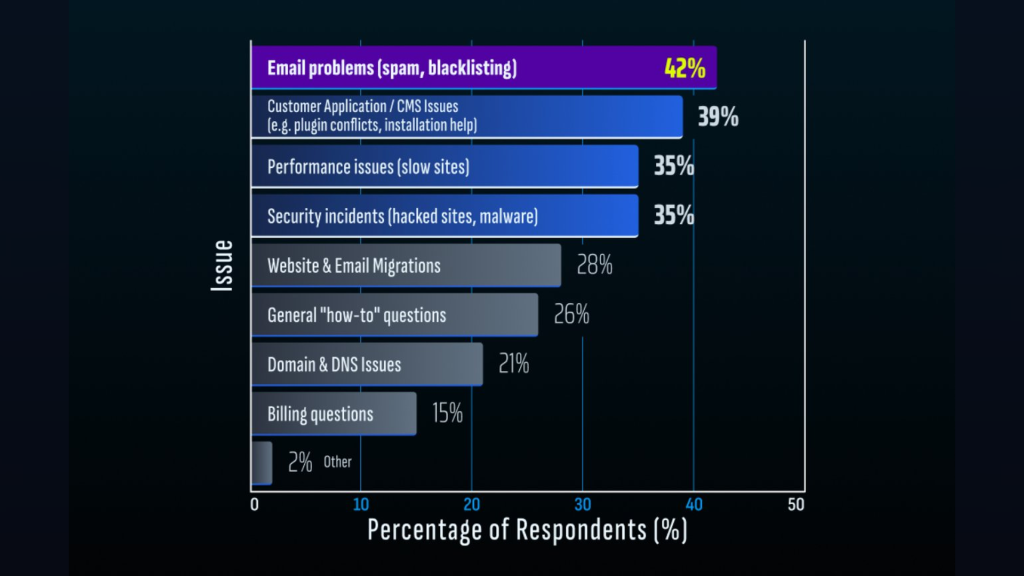
Which of the following topics consume the most support time on a regular basis?
On the security side specifically, 53% of providers cite outdated software and plugins as their biggest security challenge. 51% deal with malware and ransomware. 40% face DDoS attacks. 36% report bot traffic consuming server resources.
These are not edge cases. They are the daily operational reality for the majority of hosting providers. Every one of them is a candidate for AI-assisted automation, and providers know it. When the survey asked which AI capabilities would create the most business value, the answers tracked those pain points precisely.
What Providers Want AI to Do
Automated security and malware detection: 65%. Predictive server performance monitoring: 48%. AI-driven customer support tools: 37%. Automated content and SEO assistance: 32%. AI-assisted onboarding and migrations: 23%. Billing anomaly detection: 19%.
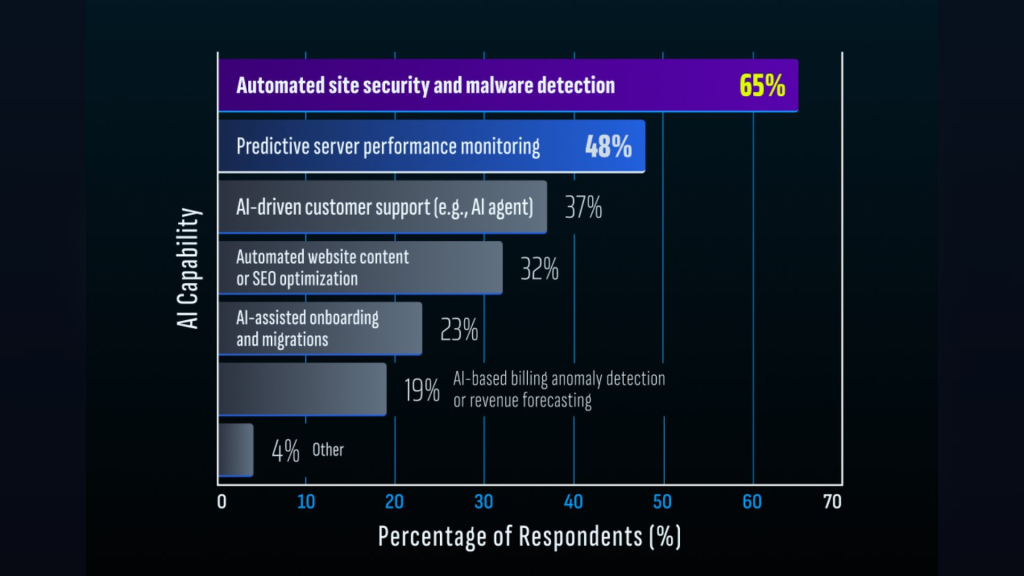
Which of the following AI-enabled capabilities would create the most value for your business?
The top two requests, security and predictive monitoring, are both about detection timing. Providers are asking for AI to identify problems before they generate support tickets, customer complaints, or security incidents. The third request, AI-driven support, is about volume reduction: deflecting routine queries so that human teams can focus on the issues that require investigation and judgment.
That pattern, catch it earlier and handle it faster, is the common thread across every AI capability providers are asking for. It also explains why operational AI is delivering faster returns than product-side AI for most providers at this stage of adoption.
Two Distinct AI Opportunities in Hosting
AI in hosting splits into two categories that serve different strategic objectives and operate on different timelines.
1. AI as an Operational Advantage
This covers capabilities that reduce internal cost and risk. AI ticket classification that automatically routes and prioritizes support requests. Automated plugin vulnerability scanning that continuously detects issues before they reach customers. Predictive capacity alerts that identify servers approaching resource limits before degradation occurs. AI-assisted incident root cause analysis that resolves problems faster by identifying likely causes from historical patterns.
These are the use cases where most providers are seeing the fastest measurable return. They reduce support load, lower security exposure, and improve response times with outcomes that are directly observable in ticket volume, mean time to resolution, and incident frequency.
2. AI as a Product Opportunity
It covers capabilities that providers offer directly to their customers. AI-assisted site creation tools like Sitejet generate layouts, content, and images to launch sites in minutes. AI-powered app and website builders like Nova turn simple prompts into live projects, giving customers a creation experience that feels as immediate as the SaaS alternatives they are comparing you to. For providers with WordPress-heavy customer bases, WP Squared brings that same AI-assisted creation and management experience specifically to WordPress environments.
AI SEO and visibility platforms like XOVI identify content gaps, track competitor positioning, and generate improvement recommendations directly from the dashboard. Performance coaching that translates Core Web Vitals data into actionable fixes, AI-powered security dashboards that surface alerts in plain language with guided remediation, and content tools that create copy and visuals on demand within site management workflows round out the category.
These capabilities build differentiation and can drive ARPU growth over time. They also address a specific competitive pressure: 41% of providers report customers leaving for SaaS platforms that feel easier to use. AI-powered customer experiences help providers compete on simplicity without giving up the flexibility and control that traditional hosting offers.
For most providers, the operational side delivers faster returns. The product side builds longer-term competitive advantage. Both matter, but the sequencing decision depends on where the most acute pressure sits in your business today.
Security Deserves Specific Attention
65% of providers want AI-automated security built into their hosting environment, making it the most requested AI capability in the survey by a significant margin. That level of demand reflects the operational reality: security issues are simultaneously one of the largest support drains, one of the biggest sources of customer risk, and one of the hardest areas to manage at scale through manual processes.
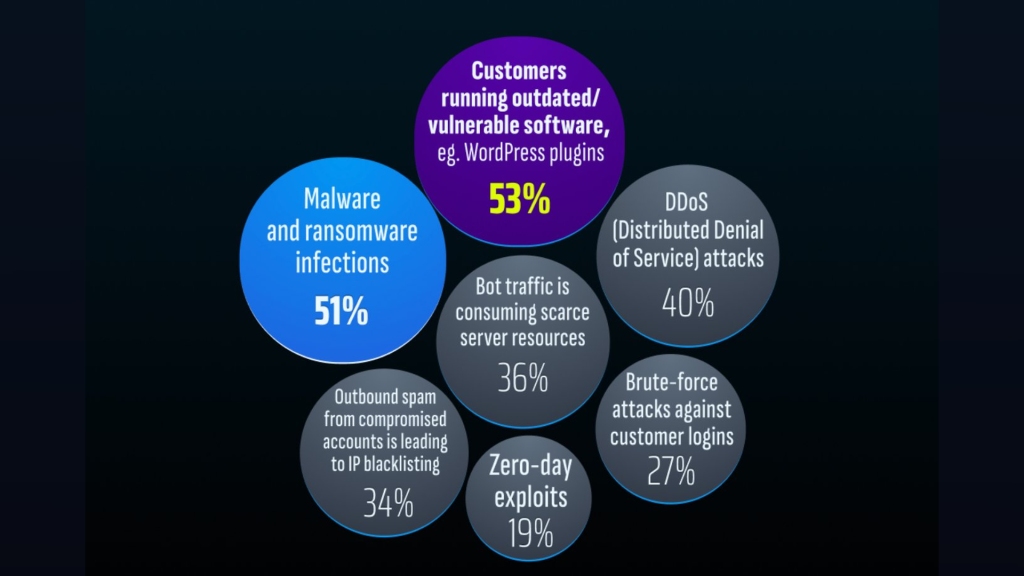
Which of the following security challenges create the most operational overhead or risk for your business?
Recent events across the hosting industry are a direct reminder that security automation applies at every layer of the hosting stack, including the platforms themselves. Rapid patching, access log monitoring, and proactive vulnerability management are operational requirements regardless of what tooling sits on top. The window between vulnerability disclosure and active exploitation continues to shrink, and manual response processes are increasingly difficult to sustain at speed.
For providers evaluating where to direct AI investment, security is the area where the data most clearly supports starting. The threat surface is broad (plugins, malware, DDoS, bots, spam), the support cost is high (35% of support time goes to security incidents), and the automation tooling is mature enough to deliver results quickly.
Your AI Checklist: Four Data-Backed Moves
Each move maps to a specific pressure point in the survey data and is sequenced with implementation realism in mind. The goal is not to do all four simultaneously. It is to start where your most acute operational bottleneck sits.
Move 1: Automate One Security Workflow This Quarter
53% of providers face outdated plugin vulnerabilities. 51% deal with malware. Both generate direct support overhead and customer risk, and both compound when managed manually across a growing fleet.
Recent events across the hosting industry are a direct reminder that security automation applies at every layer of the hosting stack, including the platforms themselves. Rapid patching, access log monitoring, and proactive vulnerability management are operational requirements regardless of what tooling sits on top. The window between disclosure and exploitation continues to shrink, and manual response processes are increasingly difficult to sustain at speed.
That same principle applies to the application and account layer, where the daily operational burden is highest. Look at your own ticket data and identify the security workflow your team handles most frequently through manual investigation, whether that is malware scanning, plugin patching, or email spam triage. Automate that one first. The support relief is immediate, the security improvement compounds, and it frees capacity for the work that requires human judgment.
Move 2: Deploy AI for Support Deflection
37% of providers want AI-driven customer support, and 36% are already using AI in support through chatbots and reply suggestions. This is where AI delivers its fastest visible return for most teams, because it directly reduces the daily ticket volume that consumes support capacity. Identify the ten most common questions your team answers every week and build guided self-service paths for them.
Whether through an AI-powered assistant, improved documentation, or structured in-product guidance, the pattern is the same: intercept routine queries before they become tickets. The technology behind it matters less than the operational habit of systematically reducing repetitive support work.
Move 3: Add AI-Powered Tools Your Customers Can Use
32% of providers already offer AI-powered tools directly to customers, including AI-assisted site creation, content generation, and SEO analysis. These capabilities give customers tangible reasons to stay on your platform rather than migrating to SaaS alternatives building AI natively into the creation and management experience.
Starting with one AI-powered customer-facing capability, whether site building, content assistance, or performance coaching, creates differentiation that compounds over time.
Move 4: Introduce Predictive Monitoring
48% of providers want predictive performance monitoring, making it the second most requested AI capability in the survey. Most monitoring tools today report on conditions that have already deteriorated. Predictive monitoring identifies the conditions that precede failures, so teams can act before an incident rather than responding to one.
For providers delivering managed services, this capability directly supports the service promise customers are paying for: maintained, reliable environments where problems are caught before they are experienced.
The Next Competitive Advantage in Hosting
53% of providers expect AI-driven automation to have the biggest impact on hosting in the period ahead, well ahead of security threats (33%) and managed WordPress demand (28%). That expectation is already translating into investment: 44% plan to invest in performance, 43% in security, and 41% in automating server management and internal operations.
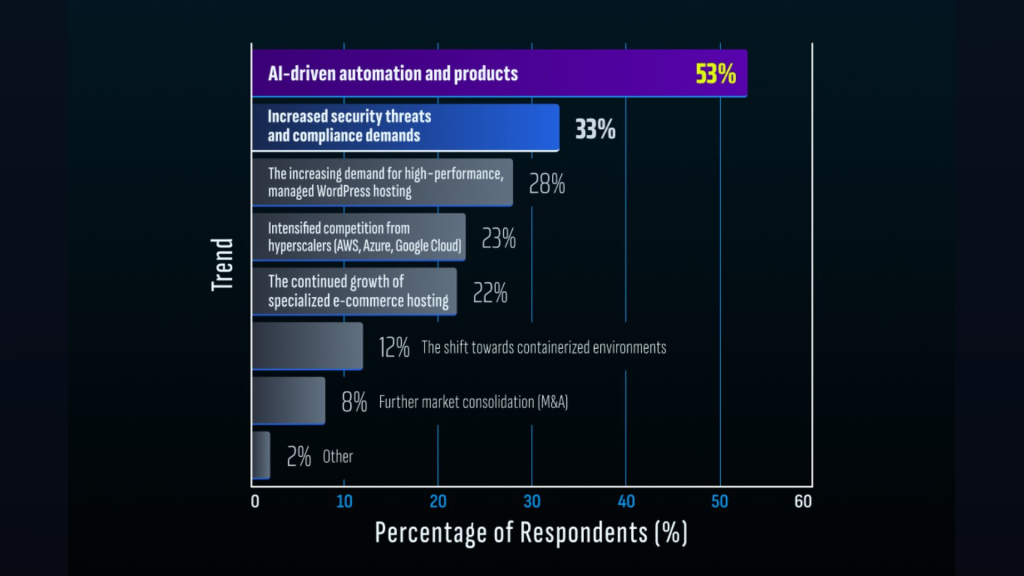
Which of these trends do you anticipate having the biggest impact on the hosting industry in 2026?
The providers who will compete most effectively are the ones who build AI into their operations one use case at a time, starting where the operational data shows the most pressure, and measuring the return clearly enough to justify the next step. The opportunity is not about adding AI features. It is about building a more efficient, more resilient hosting business for the next phase of the industry.