


At CloudFest Europe 2026, one idea kept surfacing across conversations, demos, and product launches: AI builders are everywhere.
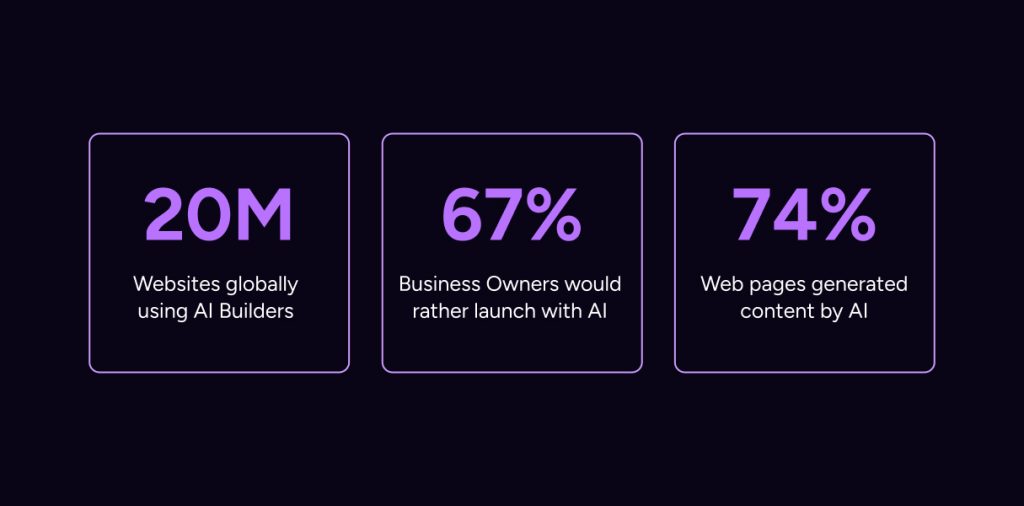
Over 20 million websites are already being built using AI-driven builders. This is no longer early-stage adoption. It is the new baseline.
And that is exactly why a single approach is no longer enough.
What started as a competitive advantage has quickly become widely accessible. If every platform can generate a website in minutes, then faster creation is no longer differentiation. It is table stakes.
This creates a deeper problem for hosting providers and agencies.
Because the question is no longer which builder to offer. It is how to support different types of customers, each with different expectations from AI-driven creation.
If everyone has access to the same capability, where does value come from next?
The answer is already emerging. The market is moving beyond builders toward systems that do not just create websites, but deliver complete, functional outcomes with minimal human involvement.
This is the shift from building tools to building agents. This does not replace existing builders. It expands the spectrum of AI-driven creation. Template-based builders continue to serve customers who want control, structure, and predictable outputs. Agentic systems serve a different need entirely, customers who prioritize outcomes over process, and are building beyond simple websites.
And it is accelerating faster than most strategies are designed to handle.
The Real Shift: From Capability to Outcome
The first wave of AI in web creation was about capability.
Can AI generate layouts? Can it write content? Can it help users launch faster?
Those questions have now been answered.
The second wave is about something fundamentally different. It is about outcomes.
Users are no longer looking for better tools to help them build. They are looking for systems that can take an idea and deliver a finished result. A live website. A working application. A complete digital experience.
This shift changes the entire value chain. Because the moment outcomes become the expectation, the process itself becomes invisible.
The traditional steps that define web creation, including planning, designing, developing, and iterating, start to collapse into a single interaction. A prompt becomes a project. A conversation becomes a deployment.
This is exactly where agentic AI enters the picture.
As highlighted during the ‘AI Builders Are Here. What’s Next for You?’ session by Michael Fowler at CloudFest EU 2026, agentic systems do not just respond to instructions. They interpret intent, plan workflows, execute tasks, and refine outputs autonomously.
That means the system decides what pages are needed. It generates content and structure together. It handles integration, logic, and backend setup. It prepares the experience for performance, SEO, and mobile. And it publishes it instantly.
All without the fragmented handoffs that defined the old model.
This is not just faster website creation. It is the removal of “building” as a multi-step process. And when building disappears as a process, any business built around that process starts to lose its edge. Once that happens, the competitive landscape shifts again.
Because if customers no longer value the effort behind creation, they start to value something else entirely:
- How quickly you can deliver a complete, working outcome
- How easily they can move from idea to execution
- How much of the complexity you can remove from their journey altogether
This is where many current AI strategies fall short. They improve the process, but the market is beginning to reduce the need for traditional processes in certain use cases.
When Outcomes Become Instant, Value Has to Move
Once creation becomes instant, something uncomfortable happens. The work that used to define value starts to disappear.
For years, hosting providers, agencies, and platforms built their businesses around the effort involved in getting something live. Design cycles, development time, revisions, and deployment. All of it carried weight because it took time, skill, and coordination.
But when a customer can go from idea to live product in minutes, that effort is no longer visible. And if it is not visible, it is very hard to charge for. This is the tension at the heart of the current shift.
AI compresses workflows to the point where traditional differentiation breaks down.
Faster delivery is no longer a premium, it is expected
Lower cost is no longer a strategy, it is inevitable
Simpler tools are no longer enough, because complexity is being removed entirely. Which forces value to move elsewhere.
The providers who continue to anchor their strategy around “building” will find themselves competing on speed and price in a race they cannot win. The ones who adapt will start to reposition around what customers actually need in this new environment.
Not the ability to build. But the ability to succeed after something is built.
That shift shows up in what customers expect next:
- Helping customers choose the right structure, not just generate one
- Ensuring performance, reliability, and scalability from day one
- Supporting continuous improvement, not just initial creation
- Enabling monetization, growth, and long-term engagement
In other words, the center of gravity shifts from creation to lifecycle.
And this is where a new opportunity opens.
Because while AI is making it easier for anyone to launch something, it is not removing the need for platforms that can support, scale, and sustain what gets launched.
If anything, that need is about to grow.
The question is whether providers are positioning themselves for that layer of value or still competing in the layer that is rapidly being automated away.
What “Moving Up the Stack” Actually Looks Like
If value is no longer in building, the next step is not to build faster. Most providers interpret this as adding AI features or replacing existing tools. In reality, it requires rethinking where they sit in the customer journey, owning what happens after something is built, regardless of how it was created.
This is where many strategies start to feel vague. “Move up the stack” sounds directionally right, but unless it translates into tangible changes, it does not hold.
In practical terms, this shift comes down to three clear moves.
1. From Builder to Entry Point
The first change is rethinking where the customer journey begins. Instead of starting with plans, configurations, or tools, the experience needs to start with intent.
What is the customer trying to create? What outcome are they aiming for?
Agentic systems make it possible to turn that intent directly into a working product. But the real opportunity for providers is to own that moment by:
- Suggesting the right structure based on use case
- Pre-configuring performance, security, and SEO from the start
- Embedding best practices without requiring user input
This shifts the provider from infrastructure to the starting point of the journey.
2. From Hosting Websites to Supporting Outcomes
Once something is live, the real work begins. This is where traditional hosting has often stepped back. The site is deployed, and responsibility shifts to the user.
That model does not hold in an AI-driven environment.
When customers can launch instantly, they also expect continuous support in making that launch successful. This is where providers can expand their role:
- Built-in optimization, not manual tuning
- Automated updates and improvements over time
- Integrated analytics that translate into actionable changes
- Growth levers that are surfaced proactively, not discovered later
The focus shifts from uptime to outcomes. The focus shifts from ‘your site is live’ to ‘your site is working.’
3. From Websites to Applications
The biggest opportunity sits just beyond websites.
Agentic systems are already capable of building full applications. These are higher-value, higher-complexity use cases that were previously out of reach for many customers.
For providers, this opens up a new layer of the stack:
- Hosting not just content, but logic and workflows
- Supporting databases, integrations, and user systems
- Enabling customers to move from “having a site” to “running a business”
This is where meaningful differentiation starts to return.
Because while websites are becoming easier to generate, fully functional applications still require an ecosystem to support them.
The Shift Is Not About AI. It Is About Ownership
At a surface level, this transition looks like an AI story. In reality, it is about ownership and:
- Who owns the entry point.
- Who owns the customer journey.
- Who owns the outcomes that follow.
AI accelerates this shift, but it does not define it.
Want to See What This Looks Like in Practice?
If you want to see how this shift plays out beyond theory, the full session breaks it down in real scenarios. From real use cases to how providers are already scaling with agentic systems, it connects these ideas to practical execution.
Nova: Turning Strategy Into Reality
All of this can sound theoretical until you see what it actually looks like in practice. This is exactly where Nova comes in.
Nova represents the next step within this spectrum of AI-driven creation. It is a clear step toward what an agentic platform looks like when it is built for providers.
Nova does not sit inside the workflow. It redefines the workflow for customers who prioritize outcomes over interfaces. This is what ‘moving up the stack’ looks like in practice.
A customer describes what they want to create. Nova interprets that intent, builds a complete website or application, structures the content, optimizes performance, and publishes it directly to a domain.
What took weeks is now done in minutes, without multiple tools, teams, or iterations. And this is not happening in isolation.
The demand for this kind of experience is already clear:
- 67% of business owners would rather launch with AI than follow traditional processes
- 54% of users cannot distinguish between AI-generated and human-built sites
This is already shaping customer expectations.
More Than a Builder. A New Position in the Stack
What makes Nova important is not just what it can build, but where it positions you. Instead of pushing providers down the stack, Nova allows you to move up.
- You become the entry point where creation begins
- You stay embedded as outcomes evolve and improve
- You expand into app building, not just websites
- You unlock new revenue streams across hosting, applications, and AI-driven services
At the same time, it is built to fit how providers operate. It is:
- White-label ready
- Integrated into existing environments
- Deployable through WebPros Cloud
This ensures that adopting AI strengthens your position instead of displacing it.
The Opportunity in Front of You
The shift to agentic platforms is already underway. AI builders made creation faster.
Agentic systems make it autonomous. The next step is deciding who owns that experience, and how broadly they can support different customer needs within it. Not as a feature to add, but as a way to rethink how you bring customers in, how you help them succeed, and how you grow alongside them.
In a market where creation is instant, advantage belongs to those who control what happens next.
Take the Next Step
This shift does not require you to rebuild everything from scratch. It requires the right platform.
Nova is built to help you bring agentic AI into your existing ecosystem, on your terms, under your brand.
If you are looking to take the next step, explore how Nova fits into your offering, identify where it can create immediate impact, and start shaping your AI strategy from a position of control.
Because the opportunity is not just to adopt AI, but to define how your customers experience it.